
We support the ecosystems that solve real problems, powered by technology and innovation.
Every community has problems. Rent is going up. Childcare is expensive. Parents are aging. Same story, different day. It’s exhausting.
It’s not a new concept that we need to do things differently. Innovate to build communities where people actually want to live and work.
Working in ecosystems to do more together also isn’t new. What is new here is the framing and scale of the network of ecosystems working together to get the job done right.
The work may prove to be difficult, and take time, but you will find that it is work worth doing. The good news is we’re here to help.

START BY THINKING IN ECOSYSTEMS
To get the most out of Meaningful Impact Hub resources to support the Innovation Ecosystem, it helps to know our version of an Innovation Ecosystem: A complex network of ecosystems working in tandem to drive positive innovation at scale.
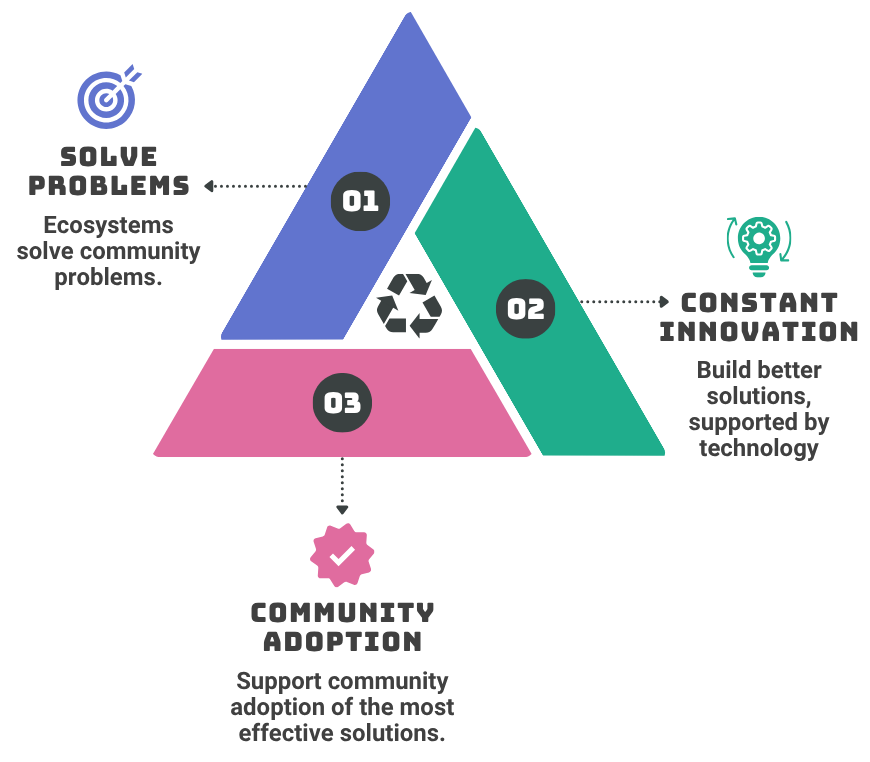
Put simply, these overlapping ecosystems find themselves in a never-ending loop of solving problems, maintaining effective solutions, innovating new solutions, and helping people find and use the right solution. Here’s how it works:
START BY SOLVING THE RIGHT PROBLEM
Hundreds of organizations exist in ecosystems to help solve problems like housing. Problems that complex are broken down into smaller problems tackled by smaller networks of organizations.
INNOVATE NEW SOLUTIONS AS TECHNOLOGY & THE WORLD CHANGES
Hundreds more organizations are inventing, leveraging and supporting technology that solves problems better. Paired with other levers that drive positive change, like policy or workflow changes.
SUPPORT ENTREPRENEURSHIP TO SOLVE OLD PROBLEMS IN NEW WAYS
When a new solution reaches enough people, hundreds more organizations support the creation of a new organization to build, scale and grow that solution to better solve the problem overall.
HELP PEOPLE ADOPT NEW SOLUTIONS THAT WILL MAKE LIFE BETTER
As new solutions emerge, resource navigators help communities at large identify, evaluate, and use the best solutions available. New solutions thrive when they’re used well and people know they exist.
INNOVATION CYCLE
MEET THE ECOSYSTEMS
We help networks of ecosystems work better together to innovate new solutions to old problems, and ensure communities get the most out of new and existing solutions. This usually means working across these ecosystems:
Problem-Solving Ecosystems
This network of ecosystems works together to solve complex problems like affordable housing.
Tech & Innovation Ecosystems
Tech ecosystems help Problem-Solving Ecosystems leverage technology to solve old problems in new ways.
Entrepreneurial Ecosystems
Entrepreneurial Ecosystems cultivate new organizations to fill gaps or positively disrupt less effective current solutions.
Ecosystem Builders
Builders work to cultivate and improve networks within their chosen ecosystem, and improve collaboration across ecosystems.
Ecosystem Navigators
Navigators connect communities with support resources and help people choose, learn, and use tech to solve problems.
Click on each Ecosystem tab above to learn our approach to how Innovation Ecosystems work together, customized to the needs of each type of contributing Ecosystem. You will discover:
OUR ECOSYSTEM BUILDING PROCESS
Some of these ecosystems already exist in some capacity while others are just a twinkle in an Ecosystem Builder’s eye. The fun part is that all communities need all types of ecosystems working in tandem to help build a better future for everyone. As you dig deeper into how each different type of ecosystem works, along with the challenges and innovation goals, you will see how far we are from the ideal vs. the current reality.
That said, we’re forming an Innovation Ecosystem Advisory Committee and syncing up with Ecosystem Builders across Nebraska to begin identifying, cultivating, or refining ecosystems to help the engine run more smoothly by offering effective support resources. We expect this ecosystem movement to start small and grow exponentially over time.
Together, we will progress through these stages to bring a comprehensive statewide Innovation Ecosystem to life:
STEP 1:
IDENTIFY ECOSYSTEMS & NETWORKS
Identify which ecosystems and networks are necessary across the full Innovation Ecosystem. This list will start with a subset and iterate with feedback.
STEP 2:
ASSESS EXISTING ECOSYSTEMS
Assess which ecosystems and networks already exist, their current stage and current level of engagement by stakeholders and funders.
STEP 3:
BUILD ECOSYSTEM PILOT PLATFORM
Select pilot ecosystems and networks to shape out an Innovation Ecosystem Toolkit and Platform to help bring siloed ecosystems together.
STEP 4:
IDENTIFY ECOSYSTEM BUILDERS
Choose or cultivate ecosystem builders in Round 2 of ecosystem and network areas to pressure test the Ecosystem Toolkit and grow Platform engagement.
STEP 5:
ASSESS CHALLENGES & SUCCESSES
Gather feedback to determine the greatest challenges and success points across ecosystems. Build ecosystem health scorecards and reports.
STEP 6:
ITERATE & SUSTAIN LONG-TERM
Incorporate continual feedback loops to iterate and improve ecosystems to sustain success long-term. Provide support services for ecosystems.
Ecosystems take time to build, and building this many working in tandem will be especially difficult. So we expect Innovation Ecosystem development to be incremental with clear goals to progress to the next stage in the ecosystem journey. Incremental progress is still better progress than where the Innovation Ecosystem exists currently.
HOW WE CAN HELP
Ecosystems are complex, so the methods by which these goals are accomplished vary by use case. Most methods build upon one another, and require multiple ecosystems working together. Here are some examples for inspiration:
Innovation Mapping sets the stage for Targeted Innovation Workshops, paired with conversations to get people on the same page
Innovation Workshops bring stakeholders together to frame problems for open innovation in Jumpstart Challenges